IJCAR 2026 Short Paper Examples
Below are code cells corresponding to the figures of the IJCAR 2026 short paper submission, plus additional details.
Figure 1
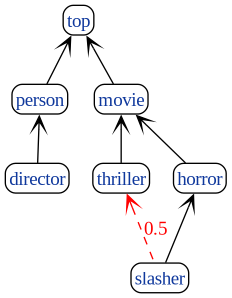
Parsing a fuzzy sort taxonomy
from fosf.parsers import parse_taxonomy
ftax_str = """
# Fuzzy subsumption declarations
director < person.
slasher < thriller (0.5), horror.
thriller, horror < movie.
# Fuzzy instance declarations
{h, 0.7/p} < slasher.
{p} < horror, thriller.
"""
ftax = parse_taxonomy(ftax_str)
print(type(ftax))
<class 'fosf.syntax.taxonomy.FuzzySortTaxonomy'>
Drawing the fuzzy taxonomy
from fosf.utils.draw import notebook_display as display
display(ftax, drop="bot", instances=False)
Accessing instances
from fosf.syntax import Sort
ftax.instances["p"][Sort("slasher")]
0.7
Computing GLBs
thriller, horror = Sort("thriller"), Sort("horror")
ftax.glb(thriller, horror)
Sort('slasher')
Checking sort subsumption
slasher = Sort("slasher")
ftax.is_subsort(slasher, thriller)
True
Computing subsumption degrees
ftax.degree(slasher, thriller)
0.5
movie = Sort("movie")
ftax.degree(slasher, movie)
1.0
Computing membership degrees of each instance with respect to a few sorts:
for mov in ["h", "p"]:
    print(mov)
    for genre in [slasher, horror, thriller, movie]:
        degree = ftax.membership_degree(mov, genre)
        print(f"{genre}({mov}) = {degree}")
h
slasher(h) = 1.0
horror(h) = 1.0
thriller(h) = 0.5
movie(h) = 1.0
p
slasher(p) = 0.7
horror(p) = 1.0
thriller(p) = 1.0
movie(p) = 1.0
Figure 2
Parsing an OSF term and converting it to an OSF clause
from fosf.parsers import parse_term
term_str = "X0:movie(directed_by -> X1:person, written_by -> X1)"
term = parse_term(term_str)
print(term.to_clause())
X0 : movie & X0.directed_by = X1 & X0.written_by = X1 & X1 : person.
We can pretty-print the OSF term
term.pretty_print()
X0 : movie(
    directed_by -> X1 : person
    written_by -> X1
)
And also draw it
display(term)
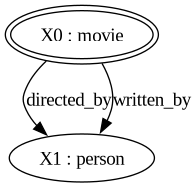
Figure 4
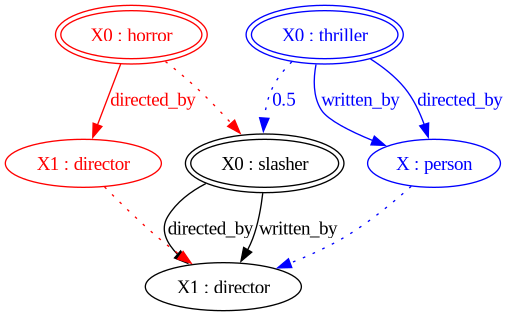
Unifying two OSF terms
from fosf.reasoning import unify_terms
t1 = parse_term("horror(directed_by -> director)")
t2 = parse_term("thriller(directed_by -> X:person , written_by -> X)")
unif, deg = unify_terms([t1, t2], ftax, return_degree=True)
print(unif, deg)
X0 : slasher(directed_by -> X1 : director, written_by -> X1) 0.5
We can draw the unification, including the tag mappings from t1 and t2 to the unifier.
from fosf.utils.draw import unification_to_agraph
display(unification_to_agraph([t1, t2], ftax))
Checking OSF term subsumption, and computing the subsumption degree
from fosf.syntax import NormalTerm
t1 = parse_term("thriller(directed_by -> person)", create_using=NormalTerm)
t2 = parse_term("slasher(directed_by -> director(spouse -> person))", create_using=NormalTerm)
unif, deg = unify_terms([t1, t2], ftax, return_degree=True)
print(unif)
X0 : slasher(directed_by -> X1 : director(spouse -> X4 : person))
The unifier is equivalent to t2, i.e., t2 is subsumed by t1, with degree deg.
unif.equivalent_to(t2), deg
(True, 0.5)
Figure 5
Parsing an OSF theory and ensuring its order-consistency.
from fosf.parsers import parse_theory
from fosf.reasoning import normalize_term
theory_str = ftax_str + """
person := Yperson:person(spouse->Y0:person(spouse->Yperson),
                         fav_movie->Y1:thriller).
movie  := Ymovie:movie(directed_by->Y2:director).
"""
theory = parse_theory(theory_str, ensure_closed=True)
Although slasher is not explicitly defined, it inherits the constraints from movie:
print(theory['slasher'])
Yslasher : slasher(directed_by -> Y7 : director)
Parsing an OSF term and normalizing it according to the theory:
t_str = "X0:person(spouse->X1(fav_movie->slasher(directed_by->X0)))"
t = parse_term(t_str)
nt, d = normalize_term(t, ftax, theory, return_degree=True)
print(nt)
X0 : director(spouse -> X1 : person(fav_movie -> X2 : slasher(directed_by -> X0), spouse -> X0))
nt.pretty_print()
X0 : director(
    spouse -> X1 : person(
        fav_movie -> X2 : slasher(
            directed_by -> X0
        )
        spouse -> X0
    )
)
The satisfaction degree of nt with respect to the OSF theory:
print(d)
0.5
Additional theory normalization example in the body of the paper:
theory_str = """
bot < s0, s1.
s0, s1 < top.
s0 := Ys0:s0(f0 -> Y0:s0, f1 -> Y1:s1).
s1 := Ys1:s1.
"""
theory = parse_theory(theory_str)
t_str = "X:s0(f0 -> X0:top(f1 -> X1:top))"
t = parse_term(t_str)
t.pretty_print()
X : s0(
    f0 -> X0 : top(
        f1 -> X1 : top
    )
)
According to the theory, X0 must be of sort s0, and X1 of sort s1.
nt = normalize_term(t, theory.taxonomy, theory)
nt.pretty_print()
X : s0(
    f0 -> X0 : s0(
        f1 -> X1 : s1
    )
)